I am an interdisciplinary social scientist specializing in the study of criminal punishment as a social phenomenon; my work, described more below, sits at the intersections of criminology, history, sociology, and sociolegal studies. I am an associate professor in the Sociology Department at the University of Hawai‘i at Mānoa. I hold a PhD in Jurisprudence and Social Policy from UC Berkeley, where I graduated in 2013. My primary intellectual homes are the interdisciplinary fields of law and society and punishment and society. From 2023 to 2026, I am co-editor (with Shauhin Talesh and Katharina Heyer) of the Law & Society Review, the flagship journal of the Law and Society Association. In an effort to generate more locally relevant research, I founded the Hawai‘i Crime Lab, which uses social science to provide useful information to Hawai‘i’s residents, visitors, and policymakers about crime and criminal justice on O‘ahu. I can be contacted at ashleytrubin@gmail.com.
One-page overviews are available for students, funders, media, and practitioners/policymakers.


My Research on Punishment
I seek to understand why we (societies) punish in the ways we do at different times and places in history.
In particular, I am interested in how penal change is possible—what causes a society to adopt new penal practices or abandon old ones, and what limits are placed on individuals’ efforts to effect change. I approach these questions through two lines of inquiry.
First, I examine punishment historically focusing on particular periods and “moments” of change. My recent research primarily focuses on the period considered the “birth” of the prison in America (1776-1865)—the period during which the prison became most entrenched in our penal imagination—but my original research extends from 1682 to ~1920. However, I seek to link these earlier periods to later periods to find connections between different instantiations of change from 1682 to the present.
Increasingly, I have become less interested in the well-documented social contextual explanations for penal change and more interested in the factors internal to the penal system, including the organizations, administrators, and front-line workers charged with meting out punishment, the technologies of punishment themselves, and the dynamics, norms, and myths within the penal field (taken together, what I call penal endogeneity). My primary research examines the lasting consequences of these internal or endogenous factors, not only for penal practice, but also for penal policy and change.
My interest in understanding punishment in historical periods and theorizing penal change is heavily informed by the field of punishment and society.
Second, I examine prisoners’ adaptations to prison life—especially those activities that have been or may be labeled as resistance. My research on prisoners’ frictional activities and political resistance seeks to understand not only why prisoners engage in such activities but also under what conditions this behavior leads to significant policy change. A major theme underlying these projects is an interest in how this behavior is interpreted by the prisoners themselves and others and with what consequences. My interest in prisoners’ adaptations is part of my larger interest in micro-level sociologies of prison. As part of that larger interest, I am also empirically examining the claim that original, but especially qualitative and ethnographic, research conducted within U.S. carceral facilities declined in the years leading up to 2000.
My interest in understanding prisoners’ friction or resistance is heavily informed by the field of prison sociology.
Why Punishment?
Understanding why we punish how we do—whether at the policy level or behind the scenes in practice—is incredibly important, particularly in the current context of American mass incarceration. Punishment is a powerful social institution that reflects and shapes important realities about a society, especially that society’s social ordering along class, race, and gender lines. Consequently, punishment affects not only those experiencing punishment, but also those beyond its technical reach. Of course, as scholars and commentators from Emile Durkheim to Fyodor Dostoevsky to Nelson Mandela have pointed out that we can learn much about a society from its penal system, especially its prisons.
Empirical Approach
I approach the study of punishment by examining penal philosophy, policy, and practice at the individual, organizational, and societal (state/national) levels. As an interdisciplinary scholar, I embrace variety, always searching for the best tools to answer my research questions. I employ both qualitative and quantitative methods and utilize both historical and contemporary data. My research spans micro- and macro-levels of analysis. I draw from organizational theory, law and society, punishment and society, criminology, legal and penal history, and prison sociology.
Publications
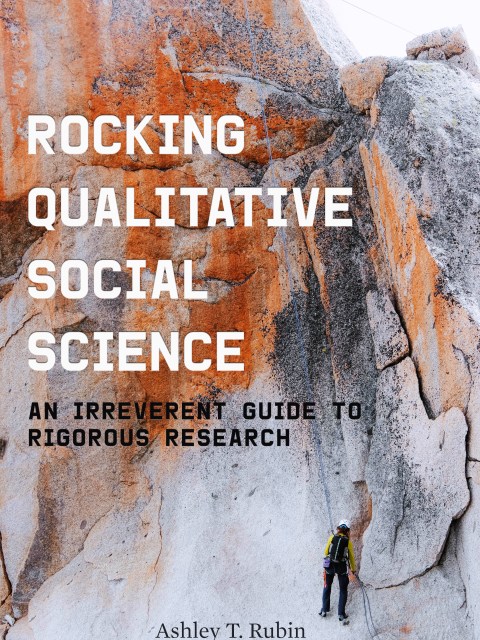
I have written two books, The Deviant Prison (about Eastern State Penitentiary and the development of modern prisons) and Rocking Qualitative Social Science (a pocket mentor and guide to qualitative research methods), both published in 2021. I am currently working on a third book, tentatively titled The American Prison: How Incarceration Became Synonymous With Punishment (under contract with Oxford University Press), and a fourth book, tentatively titled A Dirtbagger’s Guide to Writing and Productivity. My work has also been published in Law & Society Review, Law & Social Inquiry, Theoretical Criminology, Punishment & Society, the British Journal of Criminology, and the Annual Review of Law and Social Science, among other venues.
Activities
My primary professional associations are the Law and Society Association (LSA), American Society of Criminology (ASC), American Sociological Association (ASA), and the American Society of Legal History (ASLH). With Natalie Pifer, I co-organize the Law and Society CRN 27 Punishment & Society. For several years, I chaired the Punishment & Society Digital Speaker Series committee that I spearheaded in early 2018 with Sarah Lageson and Rose Ricciardelli. I am a former member of the LSA Board of Trustees, a former Secretary/Treasurer for the Sociology of Law Section of ASA, a former member of the Section Council for the ASA Section for Sociology of Law, a former member of the Section Council for the Crime, Law, and Deviance (CLD) Section of ASA. I have also chaired and served on multiple committees for the ASA Soc of Law and CLD sections.
Currently, in addition to my work as co-editor of the Law and Society Review, I am an editorial board member for Criminology and Public Policy, the Howard Journal of Crime and Justice (HOJO), and Incarceration. I am a past book review editor (for North and South America) for Punishment & Society; a past editorial advisory board member for the Law & Society Review; a past editorial board member for Law & Social Inquiry (LSI); and a past guest editor for a special issue of HOJO on path dependence and criminal justice reform (2023), an LSI Book Symposium (2019), and a special issue of Social Justice on penal history (2019).
I welcome opportunities to translate my research to larger audiences and engage in public scholarship when possible. To that end, in 2019, I gave a TEDx talk on how sending people to prison became “normal” and in 2020 (during the coronavirus pandemic), I wrote an op-ed about the importance of disease prevention to the history of early prison design and development. I have also given a number of public talks and interviews about prison history and Eastern State Penitentiary (a selection of the talks and interviews that have been recorded and archived are linked here).
I am also available to serve as an expert witness on select topics and for select consultant work. Relevant topics include research design, archival research on and explanations of prison history, and discussions of penal policy (particularly prison policy and sentencing decisions). See my consulting page for more information.
I welcome formal and informal mentorship roles with students and junior scholars and I am available to serve as an external member of thesis and dissertation committees for students working in my area.
I seek to be a major advocate for junior scholars at my home university and abroad. To that end, I organized the Junior Scholars Workshop at the joint annual meetings for the Law and Society Association and the Canadian Law and Society Association (in Toronto, Canada, in June 2018) and I have participated as a committee member, small group mentor or consultant, and speaker in three LSA workshops since then (in 2020, 2021, 2023, and 2024), as well as a junior scholars workshop sponsored by UMass-Amherst (in 2021). Finally, my book, Rocking Qualitative Social Science, (with Stanford University Press) is a friendly guide to qualitative methods aimed at early career researchers (and others new to qualitative methods); it challenges the notion that there is one right way to do qualitative methods and addresses head on the anxiety that goes with doing research (and everything else in academia). My planned sequel to this book takes this same spirit and applies it to writing and productivity by explaining the basic writing-related challenges to becoming a successful qualitative social scientist. I provide many resources on my website that I hope will benefit academics at all stages, but especially students and early career researchers and faculty.



 Ashley T. Rubin