This page offers my go-to productivity tools, which boil down to planning and time tracking.
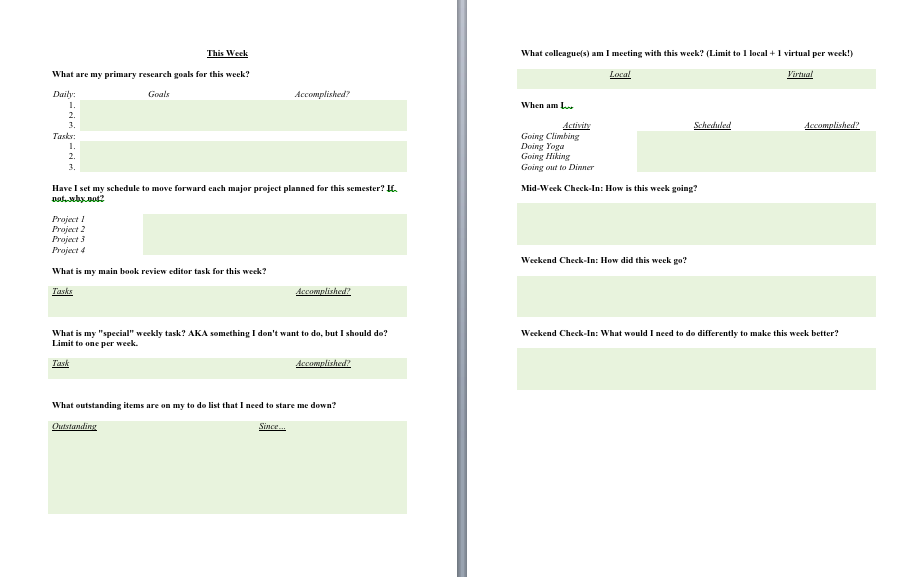
Weekly Planning. A plethora of productivity gurus, from David Allen (author of Getting Things Done) to Kerry Ann Rockquemore (creator of the Faculty Success Program), advocate having weekly planning meetings. These meetings (usually held on Friday, Saturday, or Sunday) encourage you to conscientiously think about everything you have to do and make a concrete plan for making progress on your goals. I rotate through a variety of weekly to do lists, but I recently developed a new template that builds in my personal, professional, and research goals that I especially like so I’m sharing it here. I’ve tweaked it to identify all the things I want to keep track of.
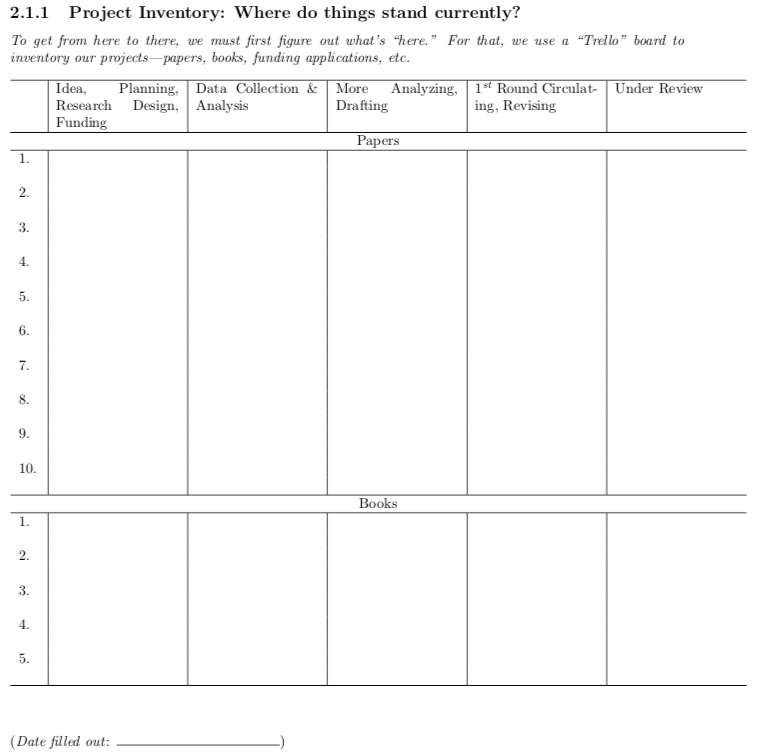
The Professor’s Planner. Because I got fed up with updating my bullet journal, and I didn’t like my word templates, I went ahead and made a full planner. It’s nothing you haven’t seen before, but just adapted for researchers who teach. Since my previous templates were helpful, I made it general enough for a broader audience (of faculty, although grad students and postdocs may also find it useful) and am posting it along with instructions. The idea is to print out the entire document and then reprint some pages as needed. This is version 1.5. I’d love to hear your feedback so I can tweak the next version!
Productivity Tracking. If you are interested in tracking your time, this is the template spreadsheet I use (updated July 31, 2019). I track everything: my emails, my exercise/health goals, service, teaching/mentorship, and various research project. (I also keep track of what’s going on that week so I can also give myself a break if other things are interfering with my work.) I track my time down to the minute, but you can choose your own strategy. The used/filled-in version looks something like this:

In addition to looking for patterns in the data about which projects I’m ignoring, I also do weekly summary analyses. I track how much time I spend working each week and how many days I did not work on research.
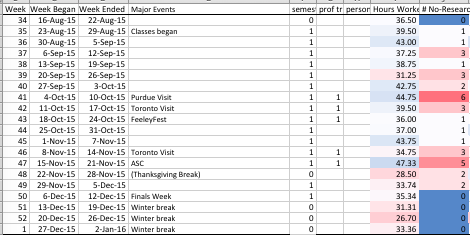
I got the idea from Paul Silva’s How to Write a Lot, but I take it a bit further and track more than my research/writing time because I find teaching, service, and other work is important for my research and isn’t always clearly distinguished. So I aim for balance.
I track my time for many reasons, but I also agree with Theresa MacPhail that “productivity is overrated.” I write about these issues in a chapter on productivity in a sequel to Rocking Qualitative Social Science, or book 4, the in-progress book on writing and productivity.
 Ashley T. Rubin